· 3 min read
An app or a shared notebook: an honest comparison
The paper version of this costs two euros and works. Here is where it wins, where it fails, and what software actually adds.
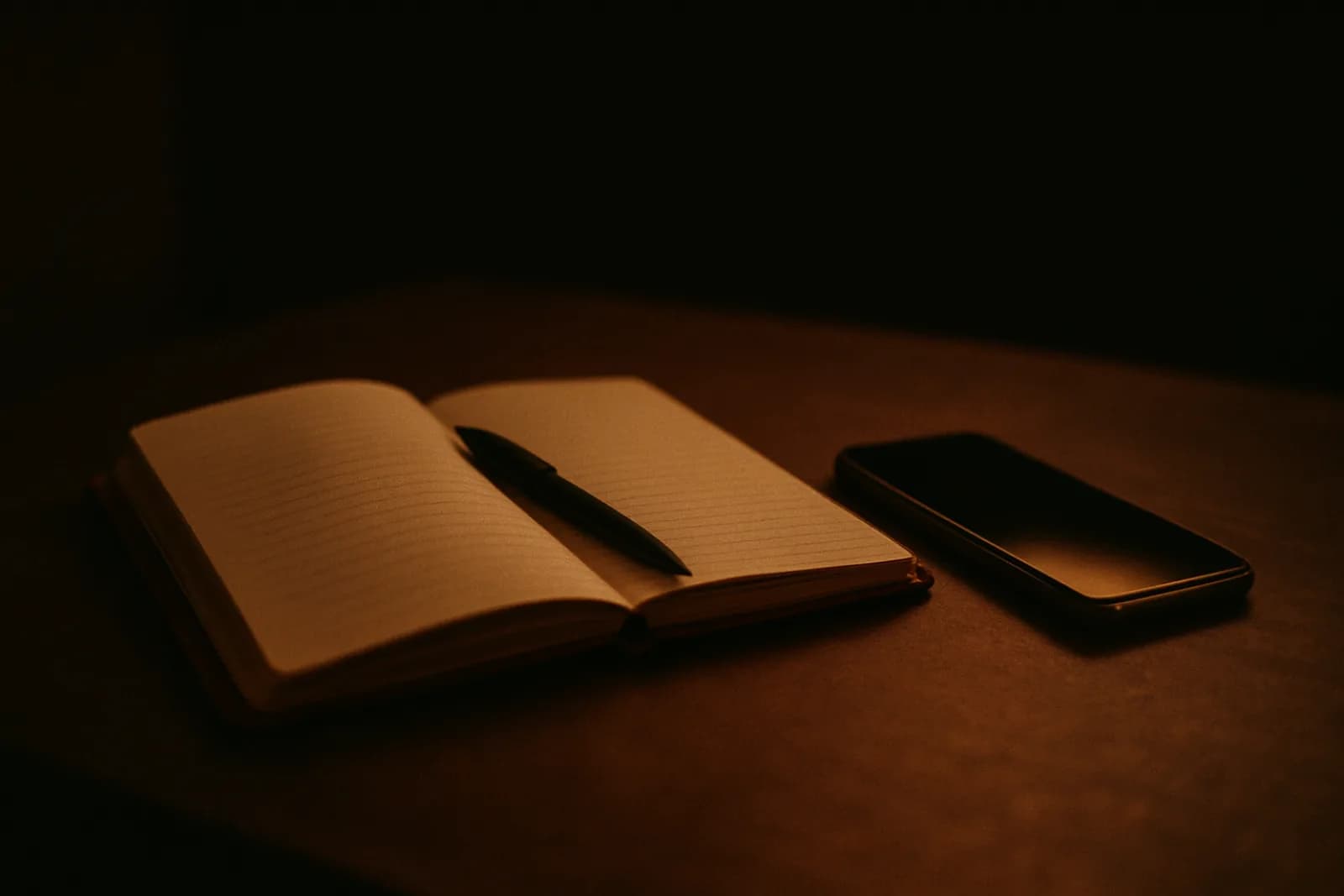
The mechanism Duoheart is built on is not new and does not require software. Two people, the same question, both writing before either reads. A notebook does this.
It is worth being straight about where each version wins, because a company that cannot describe the free alternative is not describing the product honestly.
Where paper wins
It is better to hold. Nobody has ever picked up a notebook and then spent forty minutes on something else.
It has no notifications, which means it cannot interrupt and cannot nag.
It is genuinely private in a way nothing electronic is. No account, no server, no backup, no company. If the notebook is in a drawer, it is in a drawer.
It is durable. Four notebooks from the 1980s still open. Nothing digital from the 1980s does.
And handwriting carries something. Several couples who have done both say the same thing: a handwritten line in a familiar hand lands differently, and they cannot say why.
If you will actually do it on paper, do it on paper. The mechanism is what matters, not the medium.
Where paper fails
It cannot enforce the rule. The whole value depends on neither person reading first, and a notebook on a kitchen table relies entirely on discipline. Most people are honest about this and still glance.
It requires you to be in the same building. Shift work, travel, distance and hospital stays all break it.
It requires somebody to supply the questions. Couples who write freely into a blank page tend to stop within a month, because a blank page asks nothing. The couples who keep paper going almost always have some external source of prompts.
It fails silently. Nobody reminds you, so it stops in a busy fortnight and nobody notices for a year.
And it does not survive a move, a flood, or one person deciding to throw it away.
What the software actually adds
Four things, and it is a short list.
Enforcement. Nothing is visible until both have written, and that is not a request.
The questions. Five a day, written to be answerable, which removes the main reason paper attempts die.
Distance. Two people in different countries, on different schedules, answering whenever each of them gets to it.
Encryption. Content encrypted on the devices with a key we never hold, which is the closest an electronic version can get to a drawer.
What the software takes away
Some of the tactile thing, which we cannot recover.
The complete absence of a company, which we also cannot recover, because we exist.
And it introduces a phone into the last twenty minutes of the day, which is exactly the object most couples should be removing from that slot. The honest mitigation is that it is designed to end: you answer, you read, there is nothing underneath, and you put it down. It is not designed to hold you.
Our actual recommendation
If you are two people in the same house with reliable discipline and one of you will supply the questions, buy a notebook. It is better and it costs two euros and we mean that.
If you are in different places, on different schedules, or if you have tried paper twice and it died twice, the software exists for those failure modes specifically.
The thing we would argue about is not the medium. It is whether you do it at all.
Questions people ask
- Is a notebook as good as a couples app?
- For two people in the same house with discipline and a source of questions, often better. It fails on distance, on enforcement and on supplying prompts.
- Why do paper journals for couples usually stop?
- A blank page asks nothing, so most couples run out of things to write within a month unless something external supplies the questions.
- What does an app add that paper cannot?
- Enforcement of writing before reading, a supply of questions, working across distance and time zones, and encryption of the content.