· 3 min read
Thirty Years of Notes in a Biscuit Tin
Every time one of them left the house angry, they had a rule: write it down first. Three decades later the tin is full and the marriage is intact.
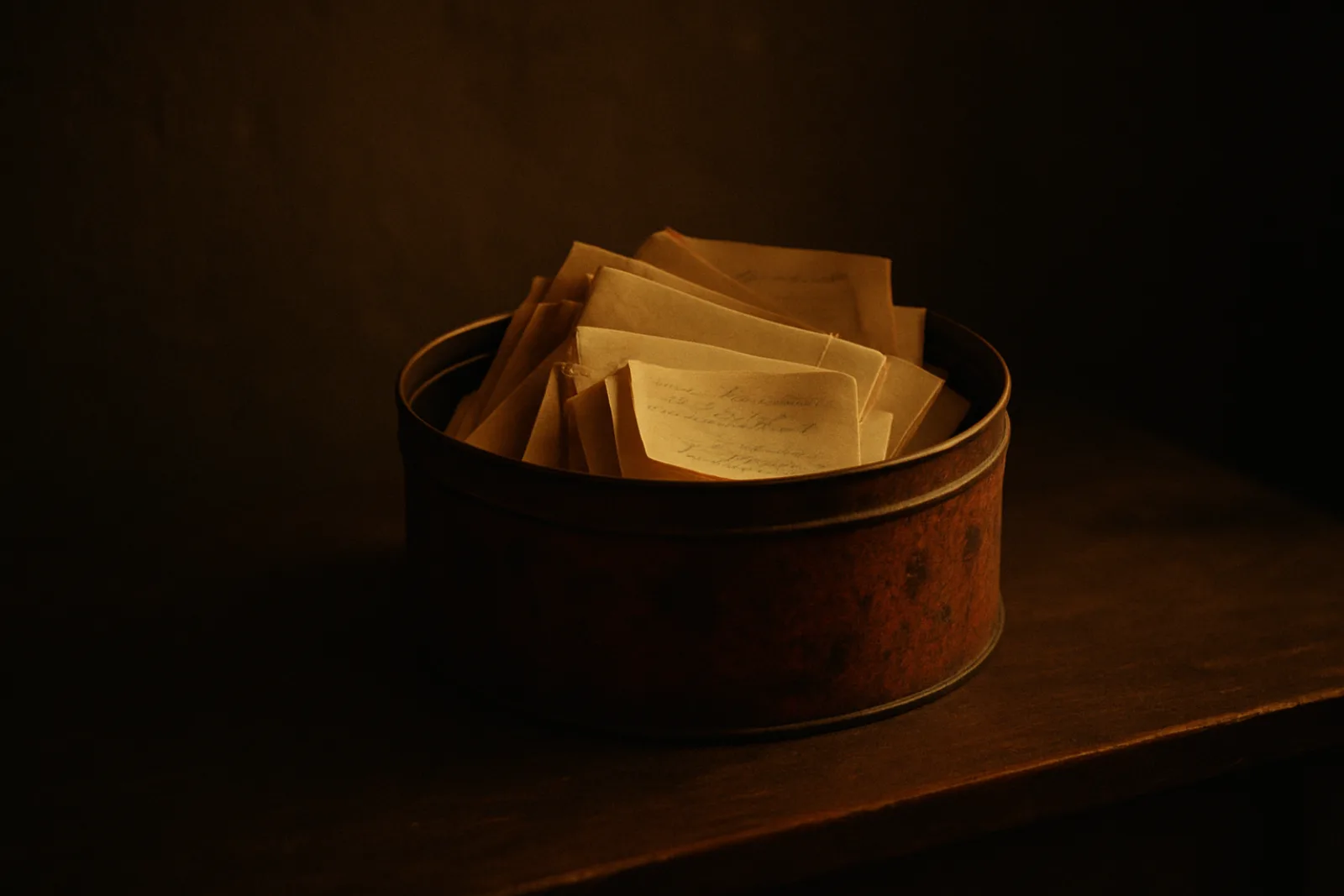
The tin is a Christmas biscuit tin from 1994 with a robin on the lid and a dent in one side. It sits on top of the wardrobe. It is full, and there is a second one now, which Tiiu says is proof of nothing except that they are old.
The rule was made in the second year of the marriage, after a Thursday that neither of them will describe in any detail except to say that Paul left the house and did not come back until after eleven, and that Tiiu spent those hours deciding things about her life that she later had to undecide.
The rule
If you are angry enough to leave the room, you write it down before you go. One side of a small piece of paper. Then you go.
That was all of it. No requirement to show it to the other person. No requirement to be fair, or measured, or to consider the other side. The notes are frequently unreasonable. Some of them are barely legible.
Paul says the point was never the writing. It was the ninety seconds.
You cannot write and slam a door at the same time. That was the whole mechanism.
What the ninety seconds did
The first thing it did was make the exit less dramatic. A person who has stopped to find a pen is no longer in the state that produces the sentence they will spend a decade regretting.
The second thing was that it made the anger specific. Shouting can stay general for a long time: you never, you always, this is typical. Writing forces a subject. Tiiu says that about a third of the time she got two lines in and discovered that the thing she was furious about was much smaller than the fury, and that this was both useful and extremely annoying.
The third thing took years to become apparent. They kept the notes. Neither remembers deciding to.
Reading them back
They did not read them for a long time. The tin was somewhere to put the paper, and putting the paper somewhere was the end of the ritual.
Then in about the fifteenth year, during a long illness in Paul's family when there was a great deal of sitting in rooms, Tiiu took the tin down.
What she found was not a record of a difficult marriage. It was a record of about nine arguments, repeated with variations, over fifteen years.
The same nine. Money and his mother and the division of a Saturday. Her habit of agreeing to things and resenting them. His habit of deciding something alone and then presenting it. A recurring one about noise. One about a holiday in 2003 that appears eleven times over six years, the last time in 2009, and never again.
She showed him. They spent an evening with the tin between them on the kitchen table, sorting the papers into piles, which is a very strange thing for two people in their fifties to be doing and which they both describe as one of the best nights of the marriage.
What they learned from the piles
That most of what had felt like a series of unrelated crises was in fact a small number of unresolved questions turning up in different clothes.
That some of them had solved themselves without anyone noticing. The noise one simply stopped in 2011, when they moved.
And that one pile was much bigger than the others and had never once been discussed in daylight. That one they did discuss, over the following winter, and Paul says it was the only conversation in thirty years that actually changed something structural.
The part they would recommend
Not the tin, particularly. Tiiu is clear that the tin is sentiment and the rule is the useful bit.
Write it before you leave the room. Do not show it to them. Keep it somewhere.
And then, some years later, when nothing is on fire, read them together and count how many separate arguments you have actually been having. Most couples, they think, would be surprised by how few there are.
There is a modern version of this that Tiiu's daughter uses, which is an app where both people answer the same question and neither can see the other until both have written. Tiiu approves of the principle and says it is the same principle, which is that the pen does something to a person that the mouth does not.
Names and details changed; the couple is a composite.
Questions people ask
- Does writing down anger help in a relationship?
- The pause it forces is usually more valuable than the writing itself. Stopping to find a pen interrupts the state that produces the sentences people regret.
- Should couples keep records of their arguments?
- Kept privately and revisited only in calm periods, they can reveal how few distinct disagreements a couple actually has. Used as evidence during a fight, they are corrosive.
- Why do the same arguments keep recurring?
- Usually because they are perpetual differences that need managing rather than solving, or because the agreement reached was too vague to act on.