· 3 min read
The Letters We Never Sent, and the One We Did
She wrote to him for two years without giving him any of it. When she finally handed one over, what mattered was not the contents.
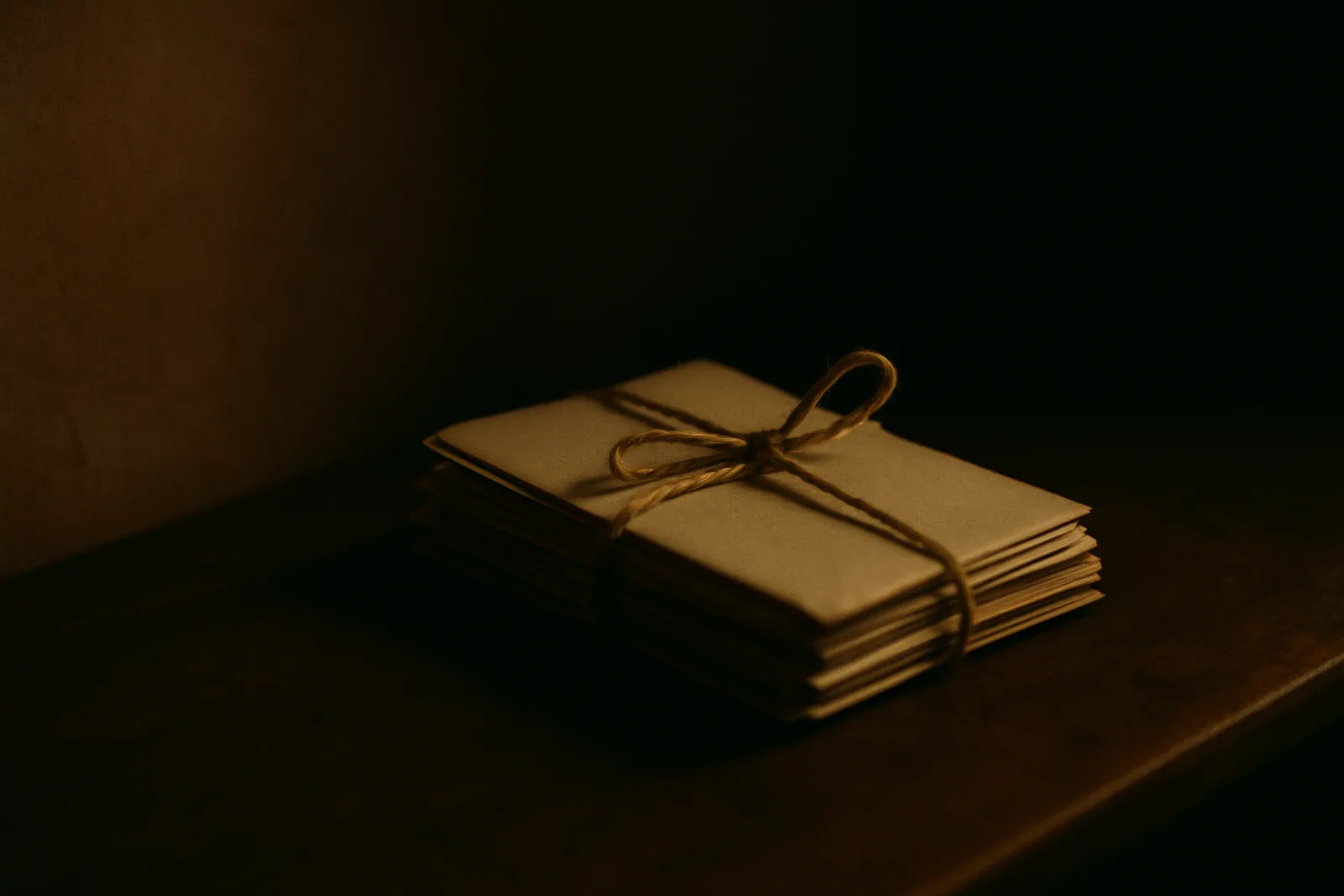
She started writing them in the second year after the baby, on a phone, in the notes app, usually at about half past four in the morning while feeding.
They were not letters in the sense of being addressed to him. They began that way and became something else: a running commentary that used him as a direction to face.
Two years of it, several hundred entries, none of them shown to anybody.
Why she did not send them
Her account is straightforward. The early ones were too angry and the later ones were too honest.
The angry ones she now considers accurate about the facts and unfair about the person. He was working long hours at a job he could not leave and she was alone with an infant in a flat, and the entries from that period are about the division of a night and about a specific sound the door made when he came home at eleven.
The honest ones were harder. Somewhere in the second year the writing stopped being about him at all and started being about what she had privately stopped expecting from her own life. She says those were unsendable not because they would have hurt him but because handing them over would have made them real.
An unsent letter is a way of saying something and keeping the option of not having said it.
What the writing did anyway
She is clear that the writing helped even though nobody read it, and she is equally clear about the limits of that.
It helped because it made the complaint specific. A grievance in the head stays general and grows. A grievance on a page has a date and a subject and can be looked at.
It did not help with the actual problem, which was that he did not know any of it. Two years of accurate private documentation of a marriage he was also in and had a completely different account of.
The one she handed over
It was not one of the good ones, which she thinks matters.
It was four lines, written on a Sunday in March, about a small thing: that he had gone to the shop without asking whether she wanted to come, and that she had cried about it, and that she knew it was not about the shop and did not know what it was about.
She put the phone in front of him and went out of the room.
He read it several times. His account of the next ten minutes is that he could not work out why it was so upsetting to read something that was, on its face, barely a complaint.
What he eventually said, when she came back, was: how long have you been writing these.
What changed
Not that he read the others. He has still not read the others and both of them think that is correct.
What changed is that they started writing to each other, which is a different activity entirely. Short, both of them, most days, on a shared thing rather than a private one.
The rule they arrived at within a month was that neither reads the other's until both have written. She had noticed immediately that when she read his first she wrote a reply rather than an entry, and that a reply is much less true.
He says the format solved a problem he had never articulated, which is that in conversation he is slow and she is fast, and that eleven years of that had produced a marriage in which her version of events was usually the one that got recorded, not because she insisted but because she arrived first.
What she says about the unsent ones
She has kept them. She does not reread them often and she does not intend to delete them.
Her view is that they were not a failure of communication but a stage of it: two years of working out what she actually thought, conducted in the only place available.
The mistake, she says, was not writing them. It was believing that because they were written, they had somehow been said.
Names and details changed; the couple is a composite.
Questions people ask
- Is it healthy to write letters to your partner that you never send?
- Writing helps clarify a complaint and make it specific. It does not communicate anything, and mistaking the writing for having said it is the common trap.
- How do I give my partner something I have written?
- Choose a small one rather than the most significant one, hand it over, and leave the room. The first disclosure is a test of how it is received rather than a full account.
- Why write to each other instead of talking?
- Writing removes the advantage of whoever is faster in conversation, and when both people write before either reads, neither answer is shaped by the other.