· 4 min read
Why "how was your day" fails and what to ask instead
The most-asked question between partners produces the least information. Here is why it collapses, and fifteen replacements that actually get answered.
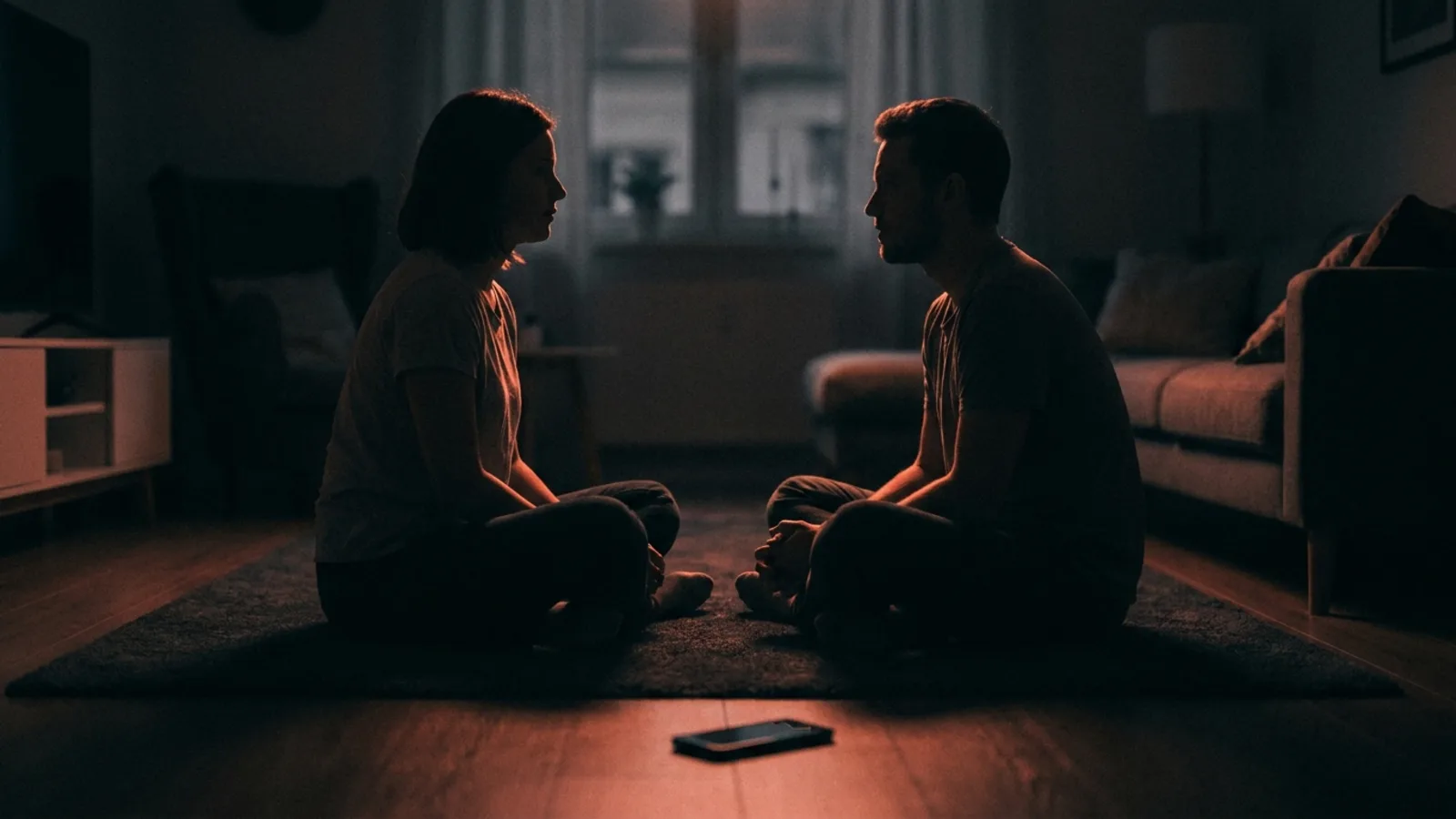
Two people who love each other will ask "how was your day" roughly seven thousand times over a decade, and receive the word "fine" for most of them. It is not a bad question because it is lazy. It is a bad question because of what it asks the other person to do.
What that question actually demands
"How was your day" asks for a summary. Summarising nine hours is real work: you have to scan the whole day, weigh the parts, and compress it into something that fits in a doorway conversation while you are still holding your keys. Faced with that, almost everyone reaches for the cheapest valid answer, which is "fine," or "long," or "same as usual."
It also arrives at the worst possible moment. It is asked in the first ninety seconds after somebody walks in, when they are still in transit between two versions of themselves. Nobody has anything sorted yet.
And it is unanswerable when the day was genuinely mixed, which most days are. A good meeting, a rude email, a decent sandwich, a sore back. There is no single accurate word for that, so people say "fine" and the conversation closes.
A question that can be answered in one word usually will be.
The three properties of a question that gets answered
First, it is specific. It points at one slice of the day rather than the whole thing, so your partner does not have to sort anything before answering.
Second, it asks for a moment rather than an evaluation. "Was it good" invites a rating. "What made you laugh" invites a scene, and scenes come with detail, and detail is where the actual conversation lives.
Third, it is easy to answer honestly on an average day. A question that only works after a dramatic day fails four times a week. "What was the most annoying five minutes of your day" works on a completely uneventful Wednesday, which is why it earns its place.
Fifteen questions to use instead
Rotate them. Any question asked identically every night eventually becomes background noise, including these.
What was the best five minutes of your day?
What was the most annoying five minutes?
Who did you speak to today that you did not expect to?
What did you decide today, big or small?
What is still sitting in your head from today?
Did anything today make you laugh out loud?
What was hard that you got through anyway?
What are you dreading about tomorrow?
What did you learn today that you did not know at breakfast?
Was there a moment today you wished I had been there for?
What did you eat, and was it any good?
What did you avoid doing today?
Who annoyed you, and did you say anything?
What went better than you expected?
If today had a title, what would it be?
Timing matters more than wording
Ask twenty minutes after your partner gets home, not at the door. Give them the shoes, the water, the change of clothes. The person who walks in and the person who sits down are not quite the same person, and only one of them has anything to tell you.
The best conditions are also sideways ones: driving, cooking, walking the dog, washing up. Shared activity with no eye contact lowers the pressure enough that people say more than they meant to. Face to face across a table is for planning. Shoulder to shoulder is for telling the truth.
This is also why a written daily question works so well for couples with mismatched schedules. In Duoheart the question arrives during the day and you both answer when you have a minute, which means nobody has to produce a good answer on demand at the exact moment they walked through the door.
When the answer is still "fine"
Sometimes "fine" is honest. The day was fine. Accept it without turning it into evidence about the relationship.
When you sense there is more, do not push with a second question straight away. Say something specific about your own day instead. Going first is a much better invitation than asking again, because it shows the level of detail you are actually offering to hear.
And notice the pattern rather than the night. One quiet evening means nothing. Three weeks of one-word answers is a real signal, and the response to that is not a better question at the door. It is a longer conversation, arranged on purpose, at a time when neither of you is holding keys.
The aim is not to interrogate your partner every evening. It is to make it slightly easier for them to tell you something true, on a completely ordinary day, when nothing in particular happened.
Questions people ask
- Is it wrong to ask how was your day at all?
- No. It works fine as a greeting. Just do not expect it to open a conversation on its own.
- What if my partner finds specific questions intrusive?
- Ask one, answer it yourself first, and let them match your level. Going first reduces the sense of being questioned.
- How many questions should I ask in an evening?
- One, usually. Two if the first one opened something. A string of questions feels like an interview rather than interest.