· 3 min read
Forty Years and One Notebook Per Decade
Four notebooks, one for each decade, written in by both of them. What they contain is not what either of them expected when they started.
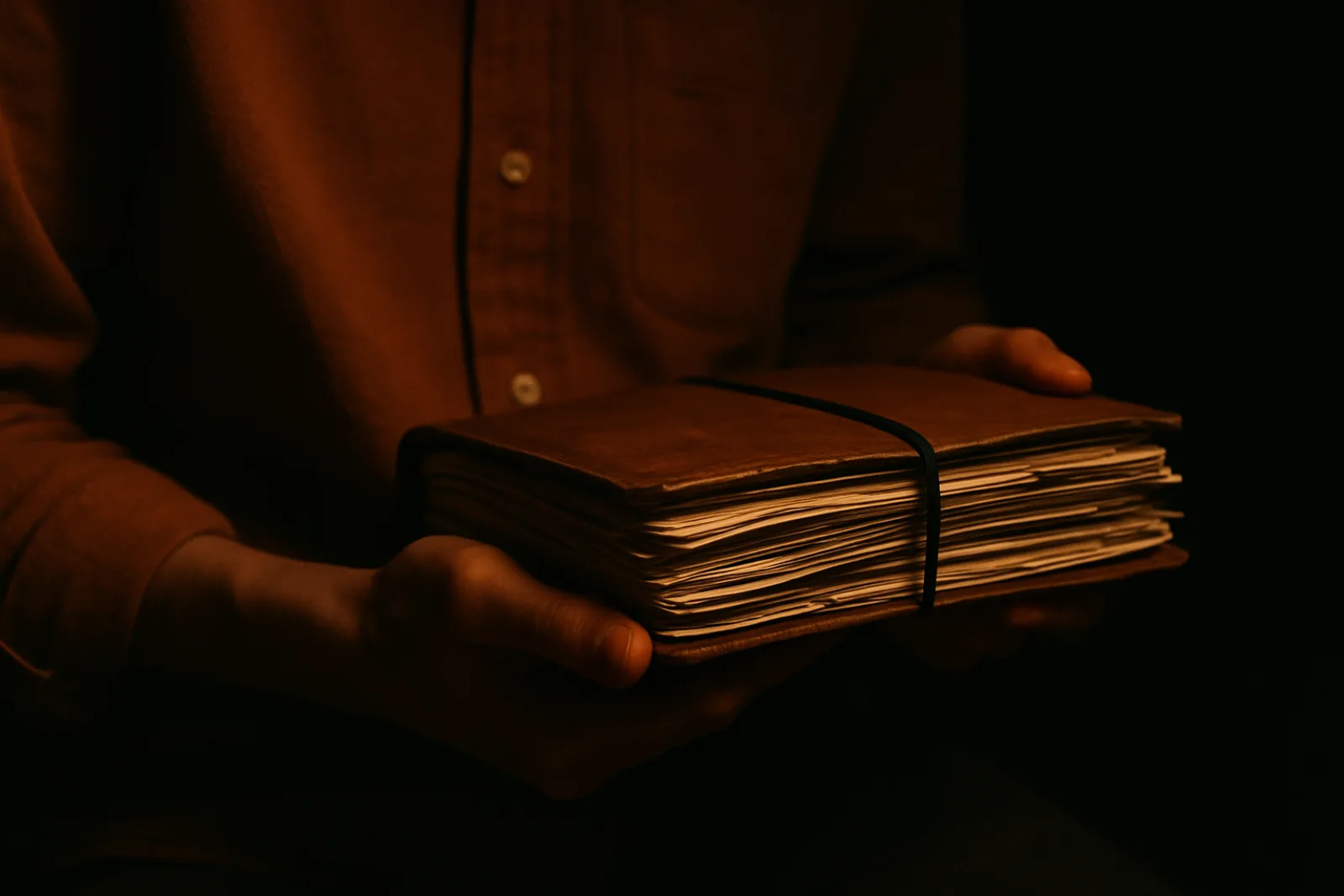
There are four notebooks. The first is a school exercise book and is nearly illegible. The fourth is half empty and they are both aware of what that means.
The rule, unchanged since 1986, is one entry a week, written by whichever of them remembers, and read by the other before the next one is added.
What is in them
Almost nothing important, if importance is measured the way people usually measure it.
There is an entry for the week they bought the house and it is four lines and two of them are about a problem with the survey. There is no entry at all for the week their first child was born, which they discovered in about 2004 and found funnier than they expected.
What is in them instead is the texture. Weather. What was for dinner an unreasonable number of times. A running complaint about a neighbour that lasts from 1991 to 1997 and then stops without explanation. Every car they have owned, with opinions.
They set out to record a marriage and accidentally recorded a life, which turned out to be the same thing.
The thing they did not plan
Neither of them intended the notebooks to be read back. They were a habit, not an archive.
The first time they read one properly was in about 1998, looking for the date of something for an insurance claim. They found the date and then sat on the floor for three hours.
What struck them both was how wrong their memories were. Not about events, which were roughly right, but about sequence and about mood. A period they both remembered as difficult turns out, in the record, to contain a great many cheerful entries. A year they remembered as good contains a six month stretch in which neither of them wrote anything except one line each week, which she says is the loudest thing in all four books.
The silent stretch
That six months, in 1993, they now discuss openly and did not discuss at all at the time.
The entries are: "Fine." "Nothing much." "Cold." Twenty four weeks of it, alternating handwriting.
He says he does not remember what was wrong. She says she does and that it was not one thing, and that what she remembers most clearly is the weekly moment of picking up the pen and deciding, again, not to.
Neither of them thinks the notebook failed. What it did was create an artefact of the silence, which meant that five years later they could see it, which they could not have done from memory.
What they would tell people starting
Do not write it for a reader. The entries that were written to be read later are the worst ones and are easy to spot, and there is a run of them in 1988 that he is still embarrassed about.
Write badly and briefly. The weeks where somebody wrote half a page are generally weeks where somebody had something to avoid.
Let one person write. They tried, twice, to have both of them write every week and it collapsed both times, because it became an obligation for whoever was busier.
And keep the dull entries. She is emphatic about this. The dull entries are what make the interesting ones legible, because a note about a bad week in 1996 means nothing unless you can see the forty ordinary weeks around it.
The fourth notebook
It is half empty. They are in their late sixties. Both of them have noticed and neither of them has said anything about what happens when it is finished.
He has started, in the last year, writing slightly longer entries. She has noticed this and has not mentioned it.
Their granddaughter uses an app that asks both partners the same question every day and holds the answers until both have written. She showed them. They agreed it was the same idea and that it would probably have suited them at thirty. Neither of them is going to switch, for reasons that have nothing to do with the format.
Names and details changed; the couple is a composite.
Questions people ask
- Is keeping a shared journal good for a relationship?
- Couples who do it tend to value the record less for its contents than for what it reveals about periods they misremember, particularly stretches of silence.
- Should both partners write in a couples journal?
- Requiring both every time tends to make it an obligation and it collapses. Alternating, or whoever remembers, survives much longer.
- What should you write in a relationship journal?
- Ordinary detail rather than significant events. The mundane entries are what make an unusual period visible years later.